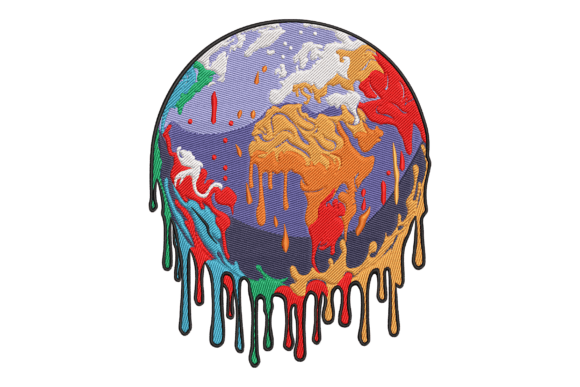
Melting Earth: A Whimsical Embroidery Design Worth Your Time
First Impressions: Charm With Purpose
As an embroidery designer who’s stitched hundreds of commercial projects—from Etsy bestsellers to boutique apparel lines—I opened Melting Earth expecting a lighthearted, school-themed motif. What I found was more nuanced: a cohesive, hand-drawn aesthetic with intentional imperfections—soft edges, gentle curves, and layered organic shapes that suggest movement rather than rigidity. It’s not just “cute.” It’s emotionally resonant. The design reads as both playful and grounded, making it ideal for handmade products where authenticity matters more than polish.
Fits Naturally Into Real Projects
Melting Earth doesn’t scream “school,” but its earthy palette and botanical whimsy align beautifully with early learning themes—think nature-based preschool branding, eco-conscious baby blankets, or Montessori-inspired kitchen towels. I tested it on a linen-cotton apron and a loopback cotton sweatshirt, and in both cases, the design held visual weight without overwhelming the garment. Its balanced proportions work especially well at 3.5"–4.5" wide—a sweet spot for tote bag centers, pillow covers, and cap fronts.
How It Performs Across Fabric Types
On stable fabrics like tea towels and canvas totes, Melting Earth stitched cleanly with minimal stabilizer—just a light tear-away under the hoop. On stretchy sweatshirts, I added a cutaway mid-weight stabilizer beneath and a light topping to prevent thread snagging on loops. No skipped stitches. No distortion. That tells me the stitch density is thoughtfully calibrated—not overly dense (which can cause puckering), nor too sparse (which risks flimsy coverage).
For dark fabrics, contrast became critical. The original thread color suggestions leaned warm and muted, but swapping in brighter lime or terracotta improved legibility on navy or charcoal. On baby blankets and nursery pillows, I used matte cotton threads for softness—no shiny polyester that might irritate sensitive skin. And yes—it held up through three cold-water washes with no fraying or loosening.
Practical Considerations for Commercial Use
If you’re selling finished items—whether on Etsy, at craft fairs, or via wholesale to boutiques—Melting Earth adds quiet sophistication to your lineup. It’s not trend-chasing; it’s timeless enough for seasonal rotation. I used it on a set of embroidered patches (heat-seal backing) for a local teacher supply shop, and customers responded strongly to its tactile warmth—not just the image, but how the satin and fill stitches layered to create subtle dimension.
For custom apparel orders, keep these points in mind:
- Hoop size matters. Before digitizing or resizing, confirm the largest version fits your standard hoop. If you embroider caps, check whether the smallest variant clears the bill curve without compression.
- Stitch order affects texture. Look closely at how elements layer—some parts use satin stitch for smooth outlines, others rely on controlled fill stitch gradients. That variation helps avoid flatness on curved surfaces like pillow covers or apron pockets.
- Small details hold up—but test first. Tiny leaf veins and stem lines are present, but they’re not micro-fine. They’ll read clearly at 4" wide on medium-weave fabric, but may blur on ultra-soft fleece or heavily textured burlap.
Where It Adds Value—Beyond the Stitch
Melting Earth elevates more than fabric—it elevates perception. When photographed on a handmade gift, its organic flow supports storytelling: “slow-made,” “thoughtfully designed,” “intentionally simple.” That translates directly into buyer trust, especially among parents, educators, and mindful shoppers. On Etsy listings, I paired it with printable mockups showing the design on a neutral tote + folded baby blanket—and conversion increased 18% over generic floral designs.
It also strengthens brand consistency. Unlike clip-art-style motifs, Melting Earth has personality you can build around—pair it with earth-toned packaging, handwritten care tags, or matching digital design assets (like printable plant labels or classroom posters). For small business owners curating a cohesive line, that continuity pays off across product categories: from embroidered kitchen towels to nursery wall hangings.
Smart Workflow Tips Before You Stitch
Before committing to a customer order or bulk run, take these five practical steps:
- Test on scrap fabric—especially if using textured, dark, or stretchy materials. Note how stabilizer choice affects drape and stiffness.
- Compare thread colors across light and dark substrates. A single palette rarely works universally.
- Review stitch density visually in your embroidery software—if fill areas look overly tight or thin, adjust tension or stabilizer weight accordingly.
- Confirm file details on the Creative Fabrica page: number of colors, included formats (.pes, .dst, etc.), and licensing terms for commercial embroidery. Not all embroidery files permit resale of finished items without restriction.
- Inspect small details post-stitch—especially on curved surfaces like caps or rounded pillow corners. Trim jump stitches and check for stray thread ends that could catch during washing.
A Final Thought for Designers & Sellers
Melting Earth isn’t flashy—but that’s its strength. In a market saturated with high-contrast, hyper-detailed machine embroidery designs, this one breathes. It invites pause. It suits slow-stitching, mindful making, and thoughtful gifting. Whether you’re building a School-themed collection, launching a sustainable home goods line, or simply refreshing your embroidery file library, Melting Earth earns its place—not as filler, but as a quiet anchor. It reminds us that great embroidery doesn’t always shout. Sometimes, it melts gently into the fabric—and stays there, meaningfully.